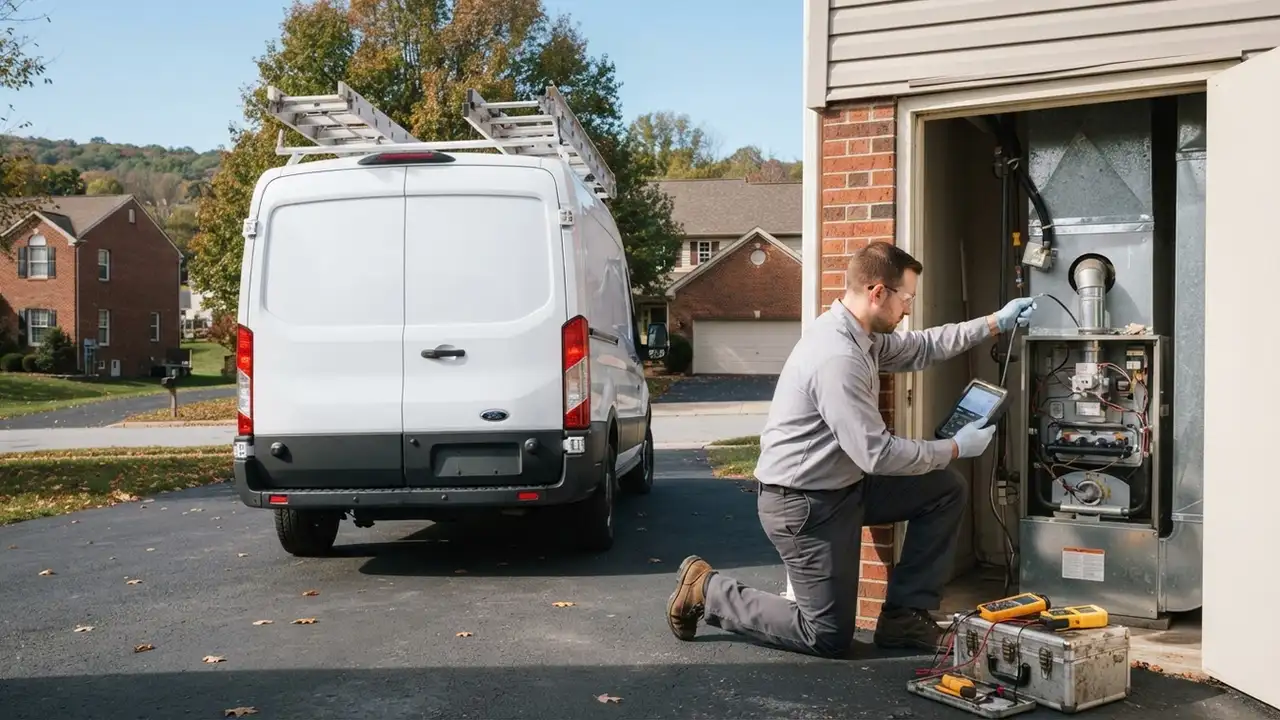
The clearest sign of a failing gas furnace ignitor is a furnace that tries to start, clicks or hums, and never lights the burners. You may also see long delays before the flame appears, or a furnace that works some days and not others. The ignitor is a small, fragile part that does a hard job, and it is one of the most common reasons we get a no-heat call in York County. This post explains the warning signs, how a gas furnace lights, and how to tell a bad ignitor from a bad flame sensor.
What Does a Furnace Ignitor Do?
A furnace ignitor is the part in a gas furnace that gets hot enough to light the gas when the burners open. Most modern furnaces use a hot surface ignitor, a small ceramic element that glows orange when power runs through it. Older furnaces use a standing pilot light, and some use a spark ignitor.
The ignitor does nothing while the furnace is off. It works for a few seconds on each start-up, then shuts off once the flame is lit. That means a furnace that cycles on and off all winter asks the ignitor to heat up and cool down thousands of times.
How a Gas Furnace Starts, Step by Step
A gas furnace follows a fixed start-up sequence every time the thermostat calls for heat. Knowing the order helps you tell which step is failing:
- The thermostat sends the signal to heat.
- The inducer motor starts and clears the burner area of air and exhaust.
- The pressure switch confirms the inducer is moving air.
- The ignitor heats up and glows.
- The gas valve opens and the burners light.
- The flame sensor confirms the flame.
- After a short delay, the main blower starts and warm air moves into your ducts.
If the furnace stops at step 4 or 5, the ignitor is a leading suspect. If it lights and then shuts off after a few seconds, look at step 6. Our page on Gas Furnace Repair in York explains each of these parts in more detail.
Warning Signs a Furnace Ignitor Is Failing
You will usually notice one or more of these before the ignitor quits completely:
- The furnace starts the inducer but the burners never light
- A visible delay of a minute or more before the flame appears
- The furnace lights some mornings and not others
- It lights on the second or third try instead of the first
- You can see through the sight glass that the ignitor does not glow
- The ignitor looks cracked, white or has visible pitting
Intermittent failure is the sneaky one. A cracked ignitor often works when it is warm and fails when it is cold, so it can leave you with heat all afternoon and none at dawn. Do not take a good morning as proof that the problem went away.
Why Does My Furnace Click but Not Light?
A furnace that clicks but does not light usually has an ignitor that is not heating, a gas valve that is not opening, or a control board that is not telling the burners to fire. The click is typically a relay or the gas valve trying to act. It tells you the furnace is calling for heat, not that the burners are getting what they need.
Most furnaces will try to light about three times, then lock out for a period of time. If you hear the same click and no flame three times in a row, the furnace has probably locked out, and it will not try again until it resets. Do not keep cycling the power. Each failed attempt only wears the parts.
Ignitor or Flame Sensor? How to Tell the Difference
The difference is simple: a bad ignitor stops the furnace before the flame, and a dirty flame sensor stops it just after. If the burners never light, suspect the ignitor. If the burners light for a few seconds and then go out, suspect the flame sensor, which is a thin metal rod that confirms the flame to the control board.
Both parts are small, and both are repaired the same visit. Our service page for Furnace Ignitor and Flame Sensor Repair in York covers how we test and replace them. If the problem turns out to be a general no-heat fault, you can also see Furnace Not Heating in York.
How Long Does a Furnace Ignitor Last?
A hot surface ignitor often lasts in the range of 5 to 7 years, though the number varies with how often the furnace runs and the quality of the part. A furnace in a cold climate that cycles hundreds of times a season will wear its ignitor faster than one in a mild climate.
Age is a warning sign in itself. If your ignitor is 5 years old or more and your furnace has started lighting slowly, treat that as the start of a failure. Replacing a worn ignitor before it fails on a cold night is cheaper than an emergency visit.
Why Ignitors Fail
Ignitors fail mainly from heat cycling, cracking and contamination. Every start heats the element to well over 1,800 degrees, and every shutdown cools it, which slowly weakens the ceramic. Touching the ignitor with bare fingers leaves skin oils that can create hot spots and shorten its life. A dirty or sooty burner area, or power surges, can also damage it.
Voltage problems matter too. An ignitor that gets weak or inconsistent power may not reach full temperature, and the furnace will try to light on a half-heated element. If your furnace has had a string of ignitor failures, a technician should check the control board and wiring, not just the part.
Common Mistakes With a Failing Ignitor
- Touching the ignitor. It is brittle, and oils from your skin can shorten its life.
- Trying to light the burners with a match. Never do this. Gas can build up and ignite unexpectedly.
- Resetting the furnace again and again. Repeated failed attempts wear the parts and waste gas.
- Ignoring slow lighting. A longer delay before the flame is an early warning, not a quirk.
- Assuming it is always the ignitor. A clogged filter, a faulty pressure switch or a dirty flame sensor can mimic it.
If you live in Red Lion or nearby, our page for Furnace Repair in Red Lion explains how we take calls from that part of the county.
When to Call a Professional
Call us when your furnace tries to start and never lights, when it takes longer and longer to light, or when it has locked out. Furnace Repair York Pros tests the ignitor, flame sensor and gas valve in order, replaces what has failed and watches the furnace through several full start-ups before we leave.
If you ever smell gas, leave the house first, then call your gas utility or 911 from outside. Do not try to light the furnace yourself.
Frequently Asked Questions
Can I replace a furnace ignitor myself?
It is not recommended. The ignitor is fragile, the part must match your furnace, and a mistake with a gas appliance is a safety risk. Our technicians replace it, confirm the wiring and test the full start-up cycle.
Why does my furnace work some days and not others?
An intermittent ignitor is a common cause. A cracked element can heat up fine when warm and fail when cold, so the furnace seems to work on some starts and not on others. A technician should test it.
Will a failing ignitor damage my furnace?
A failing ignitor mainly leaves you without heat, and repeated failed starts can strain the control board and other parts. Replacing it promptly is cheaper than letting the furnace run through repeated lockouts.
Can a pilot light furnace have an ignitor problem?
A standing pilot furnace does not use a hot surface ignitor, but it can have thermocouple or gas supply problems that look similar. Call us and tell us what type of furnace you have.
Get Help With Furnace Repair in York
If your furnace clicks, hums and never lights, we will find out why and get the heat back on.