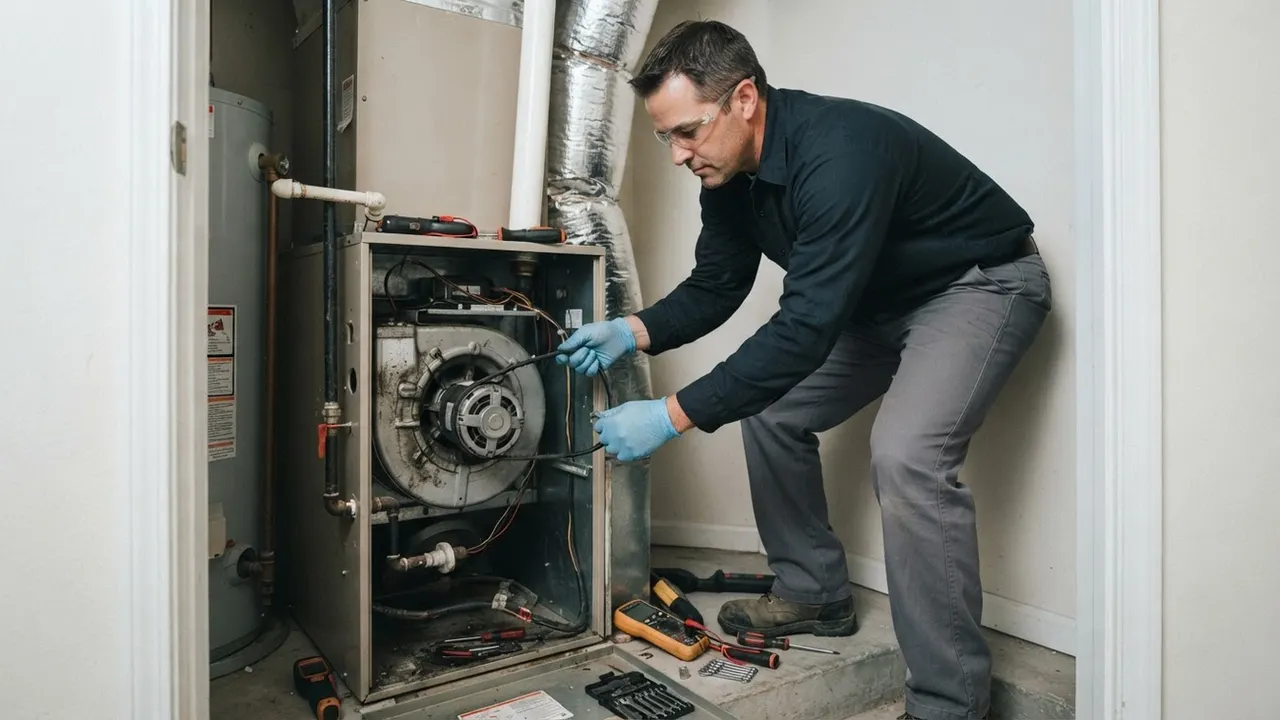
Repair your furnace when a single failed part is the problem and the furnace is younger than about 15 years. Replace it when it is 15 to 20 years old and the repairs keep stacking up, or when the heat exchanger is cracked. We hear this question from York County homeowners every winter, usually on a cold night with a dead furnace and very little time to think. This post walks through the age, cost and safety rules we use, so you can decide with facts instead of pressure.
What Does Furnace Repair Actually Cover?
Furnace repair is the diagnosis and replacement of a failed part so your existing furnace heats the house again. Most repairs are small: a worn ignitor, a dirty flame sensor, a weak capacitor, a clogged filter. You can see the full list of what we fix on our page for Furnace Repair in York.
A repair does not make an old furnace young. It fixes the one thing that broke. That is exactly why the furnace's age matters so much in this decision.
Is It Better to Repair or Replace a Furnace?
It is better to repair a furnace when the fault is one part and the unit is in its first 10 to 12 years, and better to replace it when the furnace is 15 to 20 years old and failing again and again. Between those ages, you weigh three things: the cost of this repair, how many repairs you have paid for in the last two winters, and the condition of the heat exchanger.
One repair on a furnace that has run well for years is bad luck. Two or three repairs in two winters is a pattern. Patterns do not fix themselves, and each new repair buys you less time than the last.
What Is the Life Expectancy of a York Furnace?
A gas furnace in York typically lasts 15 to 20 years, and our long heating season, running from fall well into spring, uses up that life faster than a mild climate would. Furnaces that never get serviced, or that run for years behind dirty filters, tend to wear out toward the short end of that range.
Electric furnaces often last longer, because they have no burners or heat exchanger to crack or corrode. Their blower motor and heating elements still wear, though, so the same repair-versus-replace thinking applies.
If you do not know how old your furnace is, open the front panel and look for the data plate. The serial number usually encodes the build date, and the manufacturer's website can decode it. Knowing the age takes the guesswork out of everything else in this post.
What Is the $5,000 Rule for Furnaces?
The $5,000 rule is a rule of thumb: multiply the furnace's age in years by the cost of the repair, and if the result is above $5,000, replacement usually makes more sense. A 14-year-old furnace facing a $400 repair scores 5,600, so replace. An 8-year-old furnace facing a $300 repair scores 2,400, so repair.
It is a rough guide, not a law. Use it together with the other signs in this post, never alone. A cracked heat exchanger overrides the math completely, because that is a safety problem and not a money problem.
Repairs That Are Usually Worth Making
Some faults are small, cheap compared with a new furnace and leave you with a furnace that works for years more. These are the ones we repair without hesitation:
- A failed ignitor or a flame sensor coated with carbon
- A weak blower capacitor
- A clogged filter or a thermostat that needs adjusting
- A tripped limit switch caused by restricted airflow
- A worn belt or a noisy part that is not yet failing
Many no-heat calls end with Furnace Ignitor and Flame Sensor Repair in York, a small fix on a furnace with plenty of life left. A furnace that starts and stops every few minutes is not always dying either, and a visit for Furnace Short Cycling in York often finds a restricted airflow or a sensor fault that is simple to correct.
Signs It Is Time to Replace
Signs that a furnace is ready for replacement include a cracked heat exchanger, an age of 15 to 20 years or more with repeated breakdowns, and a repair estimate that fails the $5,000 rule. Look for these:
- Visible rust, cracks or flaking inside the burner area
- A carbon monoxide alarm that sounds, or soot around the furnace
- Two or more repairs in the last two winters
- Heating bills that rise year after year with no change in how you use the house
- Rooms that never get warm even after the airflow has been checked
The heat exchanger deserves a closer look. It is the metal chamber that keeps combustion gases separate from the air you breathe. If it cracks, those gases, including carbon monoxide, can reach your living space, so a furnace with a confirmed cracked heat exchanger should not run. If you live outside the city, our pages for Furnace Repair in Hanover and Furnace Repair in West York Borough explain how we handle calls in those areas.
How Much Does It Cost to Replace a Furnace for a 2,000 Square Foot House?
The cost depends on the furnace's heating capacity, efficiency rating, fuel type and whether your ductwork needs changes, so square footage alone cannot give you a number. A 2,000-square-foot house does not automatically need one particular furnace size. A proper installer sizes the unit from your home's heat loss, not from a guess based on area.
Ask at least two installers to size the furnace that way and to quote the same efficiency level so you can compare fairly. We focus on repair, so we do not quote installations. We will, however, tell you honestly when your furnace has reached the point where replacement quotes are worth getting.
Will a Newer Furnace Lower Your Heating Bill?
A newer furnace can lower your heating bill because modern units convert more of each fuel dollar into heat. Efficiency is rated as AFUE. A furnace rated at 80 percent AFUE turns 80 cents of every fuel dollar into heat, and a high-efficiency model rated 90 percent or more turns 90 cents or more. Older furnaces can fall well below 80 percent.
The savings depend on how much you heat, how well the house holds heat and what you pay for fuel. A new furnace attached to leaky ducts will not deliver its full efficiency. Fixing the airflow and the ducts matters as much as the furnace itself.
Common Mistakes When Deciding
- Waiting until it dies. A furnace that quits on the coldest night leaves you with the fewest choices and the least time.
- Deciding on age alone. A well-kept 16-year-old furnace can be worth repairing, and a neglected 10-year-old one may not be.
- Ignoring a carbon monoxide alarm. An alarm is a reason to stop and get the furnace checked, never a reason to reset it and carry on.
- Buying on price alone. The cheapest quote often leaves out sizing or duct work that you need.
- Skipping the filter. A clogged filter shortens the life of any furnace, new or old.
When to Call a Professional
Call us when your furnace stops heating, starts making new noises, cycles on and off or fails more than once in a winter. Furnace Repair York Pros finds the fault, tells you plainly whether the repair is worth making on a furnace of that age and tests the furnace through a full cycle before we leave.
Call right away, and leave the house first, if you smell gas or a carbon monoxide alarm is sounding.
Frequently Asked Questions
Should I repair a 15-year-old furnace?
Usually yes if the fault is a single small part and the heat exchanger is sound. A furnace at 15 years is near the edge, so a large repair, such as a new blower motor, deserves a harder look against the $5,000 rule.
Is it safe to keep running a furnace with a cracked heat exchanger?
No. A cracked heat exchanger can let carbon monoxide into your home. Turn the furnace off, make sure you have working carbon monoxide alarms and have the furnace inspected before running it again.
Can one repair extend the life of an older furnace?
A repair can keep an older furnace running another season or more, but it cannot reset its age. If other parts are also worn, the next failure is likely to arrive soon, so weigh the repair against how many you have already made.
Is a second opinion worth getting before replacing a furnace?
Yes, especially if the first answer is replacement on a furnace under 15 years old. A second diagnosis costs little compared with a new furnace and can confirm that the fault really cannot be repaired.
How do I find out how old my furnace is?
Check the data plate inside the cabinet. The serial number usually includes the build date, and the manufacturer's website can decode it. If the plate is unreadable, we can often estimate the age during a visit.
Get Help With Furnace Repair in York
If your furnace is failing and you are not sure whether it is worth repairing, we will look at it and give you a straight answer.